
The most recommended introduction to Svelte, credited with sparking its adoption.
Topics › Software Engineering & Languages
The best compilers, interpreters & program analysis videos, according to Hacker News
97 videos about compilers, interpreters & program analysis that Hacker News commenters keep pointing each other to, ranked by how many separate months they were recommended. Part of Software Engineering & Languages.

HN returns to it for years as an elegant introduction to writing a lexer that is easy to follow even without a parsing background.

HN repeatedly recommends it as an amazing talk that derives the essence of Lisp and shows miniKanren-style program synthesis.

A perennial favorite, recommended as proof that expressive modern C++ can compile to efficient code even on tiny retro hardware.

HN repeatedly cites it as a striking example of Common Lisp used to push the frontier of science, and as one of the most inspiring tech talks.

HN fans call it a favorite engineering video and a showcase of Tom7's masterpiece-level, playful hacking.

HN calls it a legendary, clearly explained hacker talk whenever mov-only computing or anti-decompilation comes up.

Regarded as a brilliant live-coding talk that teaches WASM and interpreter writing, with several calling it among the best conference talks they have seen.

Frequently recommended for an experienced game-engine builder's view on why GC pauses are inevitable and why Swift's approach is appealing.

HN recommends it as an entertaining, mind-blowing look at compiler cleverness from a great speaker.

HN readers say it changed their view of APL and array languages, with a clear walkthrough of how a compiler can be written in this style.

HN keeps citing it as proof of how advanced a GC-based systems language and integrated workstation were decades ago, and as a model for what desktop OSes could be.

HN treats Cliff Click's talks as an excellent source on JVMs, garbage collection and hardware-assisted Java.

Recommended as the clearest explanation of why immutable data need not be slow, and as the introduction to Roc.

HN recommends it, and Cliff Click's talks in general, as practical wisdom from someone who built HotSpot and worked on Azul's VMs.

A repeated recommendation for anyone interested in VMs, with Click's talks regarded as unusually informative on JVMs, JITs and the user/kernel boundary.

Recommended as a fascinating look at easy parallelism abstractions, though other commenters note the approach never beat sequential C by much.

HN cites it in C++ versus Rust safety debates for its lifetime profile demo, and recommends it as a modern C++ talk.

HN points to it whenever benchmarking pitfalls and layout effects come up, as an eye-opening talk on how unreliable naive measurements are.

HN points to it as the best explanation of tree-sitter's design choices and as an accessible introduction to parser generators.
HN refers to it as the main public description of Google's internal code analysis tooling, and as a precursor of ideas like LSP.

Recommended as a jaw-dropping, must-see talk that gives an amazing intro to static analysis alongside Might's personal story.

HN points to it as the best account of what Self made possible and what its team went on to do.

Recommended as the clearest explanation of Halide's ideas and of scheduling for performance.

Recommended as a well-researched rebuttal of the idea that Nintendo simply forgot an optimization flag.

HN commenters recommend it as a way to understand what the VPRI group considers core, such as supporting any syntax on one JIT compiler and removing boundaries between application and interpreter.

HN points to it whenever undefined behavior comes up, as the best explanation of the reasoning behind UB, though some dispute its framing.

HN points to it as an impressive look at how far WebAssembly can go, and as the explanation of the architecture behind CheerpX and its Flash support.

HN recommends it as a detailed, entertaining look at the crazy optimizations compilers do.

HN commenters recommend it as a clear, dense hour on parsers and parser combinators that holds the audience.

Held up in Lisp threads as a striking example of Lisp powering cutting-edge science.

Recommended for explaining where the compiler ecosystem lacks standardization for accelerators and why efforts like MLIR and CIRCT matter.

HN points to it as the best explanation of why R is so hard to optimize, often paired with talks on Python and used to explain what makes Julia fast.

HN points to it for background on how the Go toolchain targets many architectures and why its assembler is designed that way.

HN recommends it as a hands-on way to understand Haskell and parser combinators by watching a parser get built live.

HN recommends it as a quick, wonderful look at infinite towers of interpreters and what they make possible.

Pointed to as the origin story of Hack and a real-world example of OCaml in production.

HN points to it as the main place to hear Lattner's motivations and design ideas for Mojo, often in Mojo threads.

HN points to it as the best explanation of simdjson internals and of why fast parsing is rarely disk-bound.

HN points to it as the best deep dive into Mojo's design, including MLIR use and SIMD-first scalars.

HN loves the Browser hacking series for its clear debugging method of reducing bugs to minimal reproductions, which people say influenced their own testing.

Recommended as a good watch on how Go's M:N:P scheduler works and why it was designed that way compared with alternative schemes.

HN mentions it as the author's own overview of Pixie, with an interesting implementation technique near the end.

Cited in Scala debates as an insider's critique that persuaded many the language's problems were deep.

Pointed to as a primary-source interview on Apple's architecture transitions, emulation and microcode work.

HN cites it as the language creator's honest account of Julia's weaknesses, useful for anyone evaluating the language.

Recommended as the canonical introduction to tree-sitter and why fast incremental parsing enables live editor support.

Pointed to as the authoritative source on Go's GC pause improvements, and later revisited when GC latency claims were challenged.

HN recommends it for specifics on how Truffle and Graal achieve strong dynamic-language performance.

Recommended as the clearest explanation of how Swift generics compile and how that differs from other languages.

Recommended as a real-world case of Lisp in a cutting-edge industry, applied to quantum hardware.

Shared in Crafting Interpreters threads because it shows the care behind the book and is satisfying to watch.

Recommended as the source on how Compiler Explorer began and for its lesser-known features like the machine code analyzer.

Commenters cite it as the authoritative source for why the port is faster and why Go was chosen.

HN lists it among the practical entry points for learning Z3 and formal verification.

Recommended as a practical, approachable build-it-step-by-step introduction to writing compilers, light on theory.

HN commenters point to it as an interesting conversation with the creator of Swift and LLVM, especially for compilers and ML compilation.

It is the go-to explanation of how CPython's JIT works and why its design is so simple.

HN holds the SICP lectures up as joyful classics, and this lecture as the moment the evaluator is revealed.

HN recommends it because hearing pioneers explain early computing in their own words conveys the context and excitement of the era.

HN commenters hold it up as an unmatched introduction to programming and quote Sussman's line that knowing a spirit's name gives you power over it.

HN points to it for understanding Glimmer and Ember's view layer, and as a reference for opcode-compiled templates.

HN points to it as the authoritative answer to why the team picked Go rather than C# or Rust, citing timestamps on cyclic data structures and garbage collection.

Recommended as one of the best talks of the symposium for the unusual scope of applying Lisp to molecular design.

HN points to it as the authoritative source on Zig's direction, especially why async was removed and why the toolchain is changing.

Shared as the place to see where the Zig project is heading, especially on compiler performance.

Cited as the authoritative source on how Mill's VLIW-style compiler specializes code and differs from Itanium.

Pointed to as a general-purpose interview on Mojo's goals and design from its creator.

Cited in discussions of why Clang exists and its case against GCC.

Cited alongside compiler-construction resources as the go-to talk on the nanopass approach used in Chez Scheme.

Pointed to as the canonical presentation of compile-time regex in C++ and its template metaprogramming, including benchmark results.

Pointed to as practical talk on off-heap memory and database programming in Lisp by experienced engineers.

Cited as an insider's critique of Scala and of non-incremental compilers, often by people warning others off Scala.

HN cites it as an early demonstration of compile-time code execution, predating its popularity in languages like Zig.

Cited in APL and Julia threads as a neat way to run APL-style syntax at Julia's speed.

Recommended as a recent take on rethinking compiler architecture, and cited in discussions of flattened ASTs and fast lexers.

Mentioned as a great talk and related reading in threads on parsing techniques.
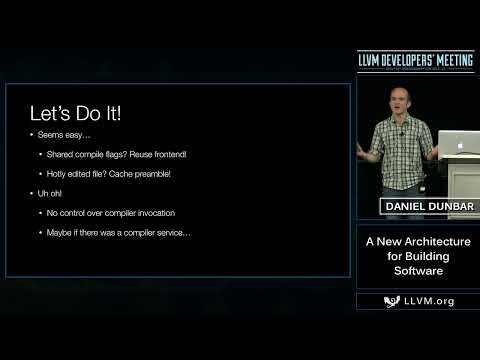
Cited in build-system and C++ compile-time threads as Apple's work on incremental builds and the design behind llbuild.

Cited in discussions of memory arenas and allocators as the origin of the implicit context idea that later appeared in Odin and other languages.

HN lists it among C++ optimization talks and cites it for how much optimizer performance comes from inlining, from an experienced compiler engineer.

Cited in PHP compiler and language-implementation discussions as an honest account of the real difficulties of compiling dynamic languages.

Shared in discussions of useCallback and memoization as the first look at where React was heading with an auto-memoizing compiler.

Mostly cited by the author himself as the introduction to Clasp and Cando, and recommended to those wanting Lisp with C++ library interop.

Mentioned as an interesting Lattner conversation whenever Swift, LLVM or language design come up.

HN points to it as the primary source on Dalvik's dex bytecode, register-based design and memory-saving choices.

Cited as the source for Google's Swift for TensorFlow effort, later remembered as a once-hyped ML language.

HN commenters cite it as the classic explanation of eval and the meta-circular evaluator.

HN commenters cite it as a concrete example of how a skilled developer uses Copilot, mostly as fancy autocomplete for codebase-specific work.

HN cites it as Apple's own explanation of why Embedded Swift exists and what it targets.

Mostly cited as the source of Hotz's AMD driver rant, which some commenters found validating and others found unflattering.

HN cites it as public evidence that Twitter ran GraalVM in production and saw significant performance improvements.

Cited as the origin of the compilers-as-databases idea in discussions of IDEs and incremental tooling.

Cited in AOT discussions as evidence that Oracle was moving toward AOT in the JDK and as an explanation of the deoptimization concerns.

HN cites it as an early demo of projectional, AST-based programming whenever editors, code views or non-text programming come up.

Referenced mainly for Bak's firsthand account of why the Dart VM never shipped in Chrome and for his IoT language design points.

Cited in Swift discussions for Lattner's account of Swift becoming complex too fast under pressure from Apple's needs.

HN links it as the original announcement of Lumen (later Firefly), for people wanting technical detail on the project.
Which of these have you already seen?
Connect YouTube and HackerTube AI hides what you've watched and ranks the rest for you.